|
Site Search
* * * * *
Wanted to
Buy
* * * * *
Antiques
For Sale
* * * * *
Antique
Tools:
Stanley Planes
& Tools
Patented &
Wooden Planes / Levels / Bevels
Squares / Rules
Chisels / Slicks
Saws & Drills
Farm & More
Antique
Sewing
Machines:
Singer 221-222
Featherweight
Sewing Machines
Featherweight
221-222
Information
Featherweight
Testimonials
Antique
Surveying
Instruments:
Solar / Mining
Transits
Compasses
Levels
Tripods
Chains
Americana
Technology
Scientific & Electrical
Antiques
Advertising
Patent Models
Salesman Samples
Country Store
Office / Electric
Calculation
* * * * *
General Info:
Ordering &
Guarantee
FAQ / Questions
About Our
Antique Business
Relevant Links
* * * * *
Contact
Patented-Antiques
* * * * *
Site Search
* * * * *
|
Antique / Vintage & Collectible
Surveying Instruments
& Tools
* * * Click Page Titles to See Items
* * *
- Lietz Mining Transit
- K & E / Keuffel & Esser c. 1919 # 5074 Engineers Mountain & Mining Transit
- 1880s RARE W. & L. E. Gurley Aluminum Solar Compass
- Japanese WWII TOKO 10 x 5 Transit / Theodolite
* * * Click
Page Titles Below to see Items * * *
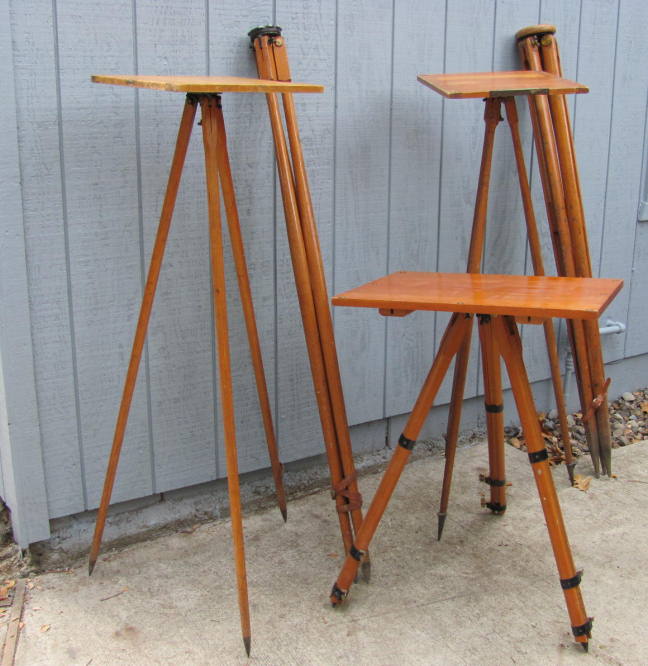
- Fixed & Collapsible Leg Tripods
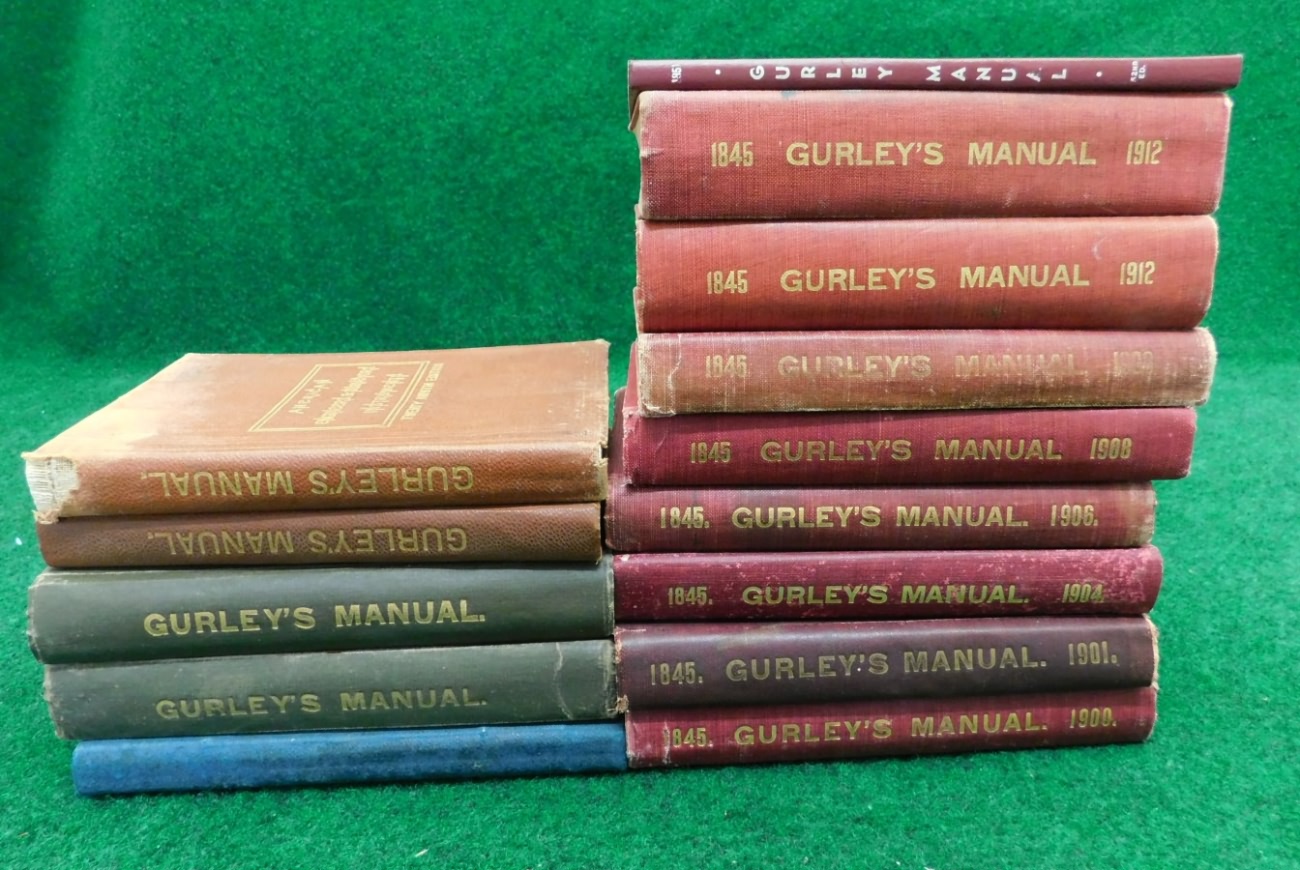
- Selection of Surveying Instrument Catalogs
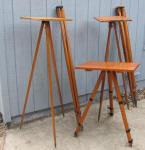
- Hago Co. No. 240 / West Germany Drawing / Drafting Instrument Set
- K & E / Keuffel & Esser Both's Patent No. 1160 Section Liner
- 6" Folding Ivory Sector / Scale / Rule
- 6" Folding Ivory Sector / Scale / Rule
- Stanley / London 6" Ivory Protractor / Scale / Rule
- 6" Ebony Parallel Rule
- J. Long London Proof Slide Rule
- Charvoz 10" Proportional Dividers
- K & E / Keuffel & Esser Compensated Altimeter / Barometer
* * * Click
Title ABOVE to see Additional Items * * *
- 1893 A. Lietz San Francisco Instrument Catalog $275.00
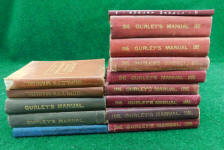 - 1899 A. Lietz San Francisco Instrument Catalog $225.00
- 1898 C. L. Berger Catalog $295.00
- 1908 Berger Catalog $195.00
- 1940 Berger Catalog $35.00
- 1910 Dietzgen Catalog $95.00
- 1955 Dietzgen Catalog $30.00
Here is a link to a website that can help you
date your surveying instrument if you are looking for that info.
https://www.surveyhistory.org/how_old_is_my_instrument.htm
Antique / Vintage & Collectible
Surveying Instruments
A Brief Introduction / History
Surveyors and the instruments they used played
an important part in the development and history of
America. Dividing up the land and determining passages and routes
across
 the land were important to the growth and development
of this country. From the earliest Colonial times
surveying the land and determining how to get from point
A to point B and beyond, and who owned what, was of vital concern.
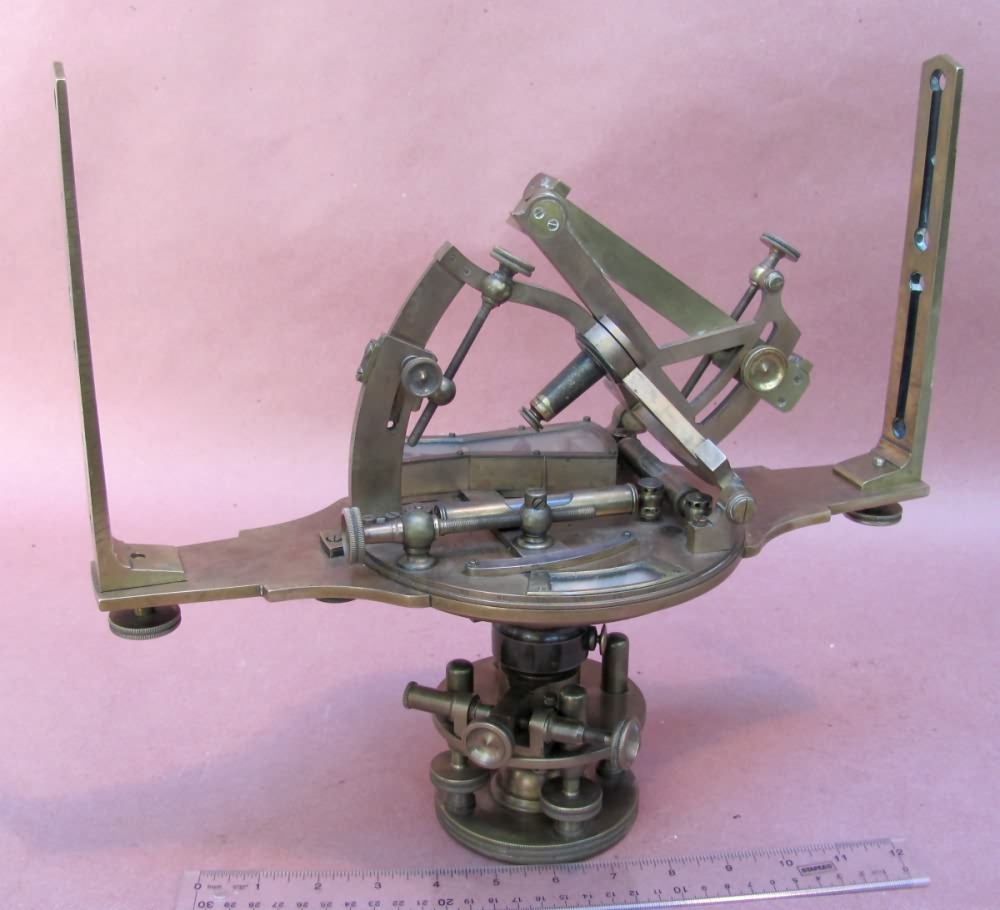
The earliest instruments used for surveying prior to the development
of compasses included devices such as circumferentors, quadrants and sextants
whose origins and use are most commonly associated with maritime
navigation. The need for more precision as well as portability led
to design changes and improvements in the known designs for
instruments used on land. What generally became known as survey
compasses became the standard for day to day use by surveyors here in America.
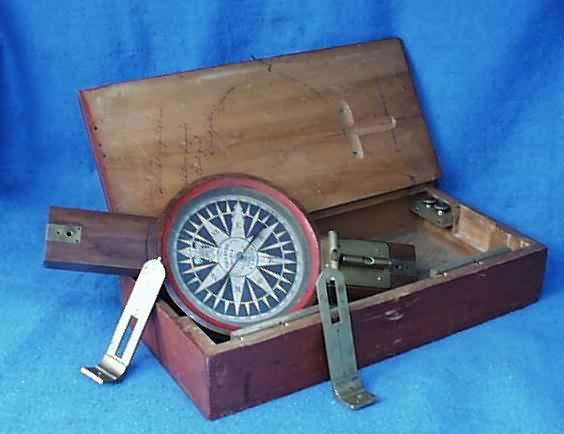
The earliest American examples were made of either brass or primitive
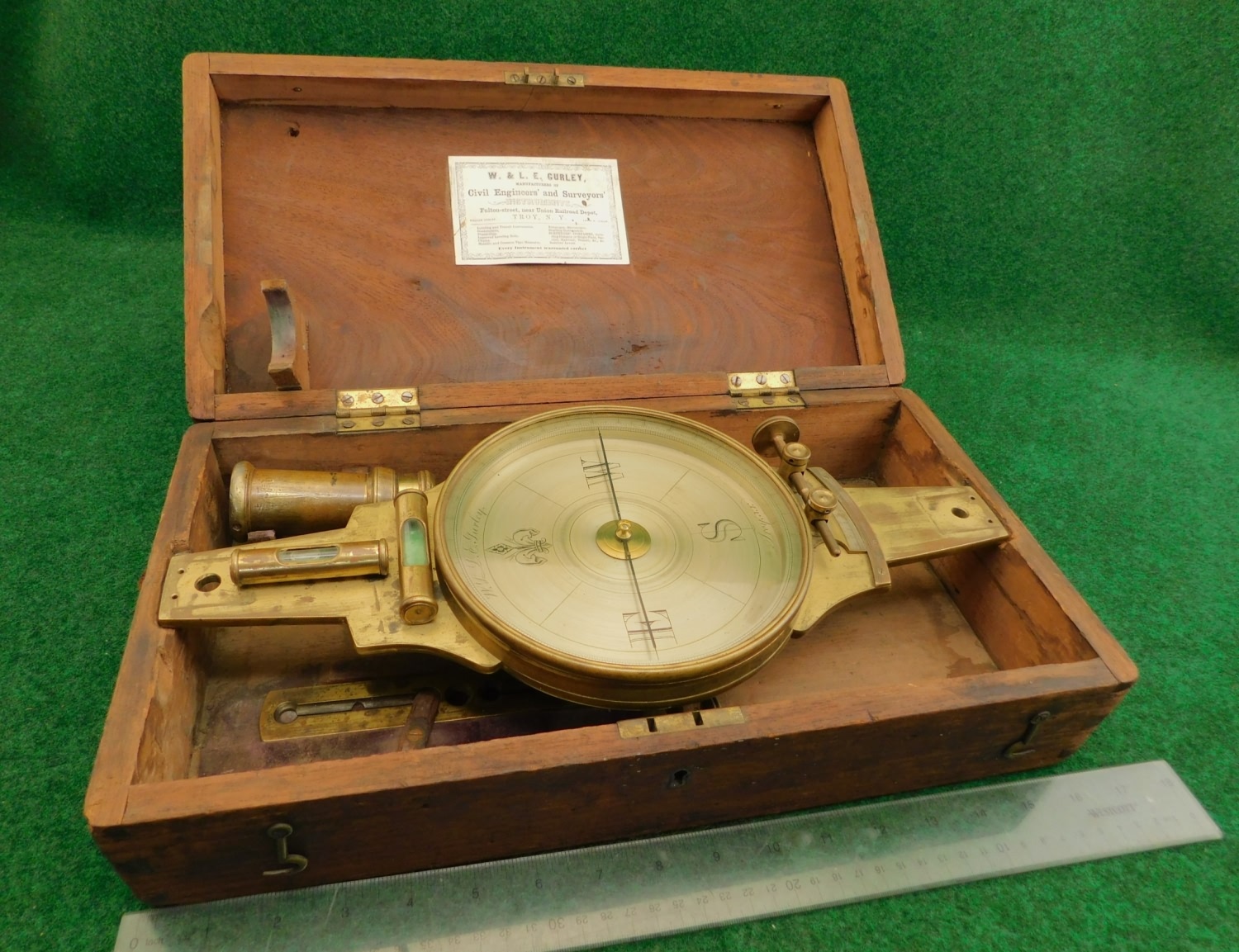
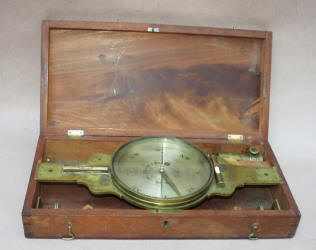
wooden bodied surveying compasses. 18th century instruments dating from the colonial era occasionally turn up but are very rare. Different forms or designations
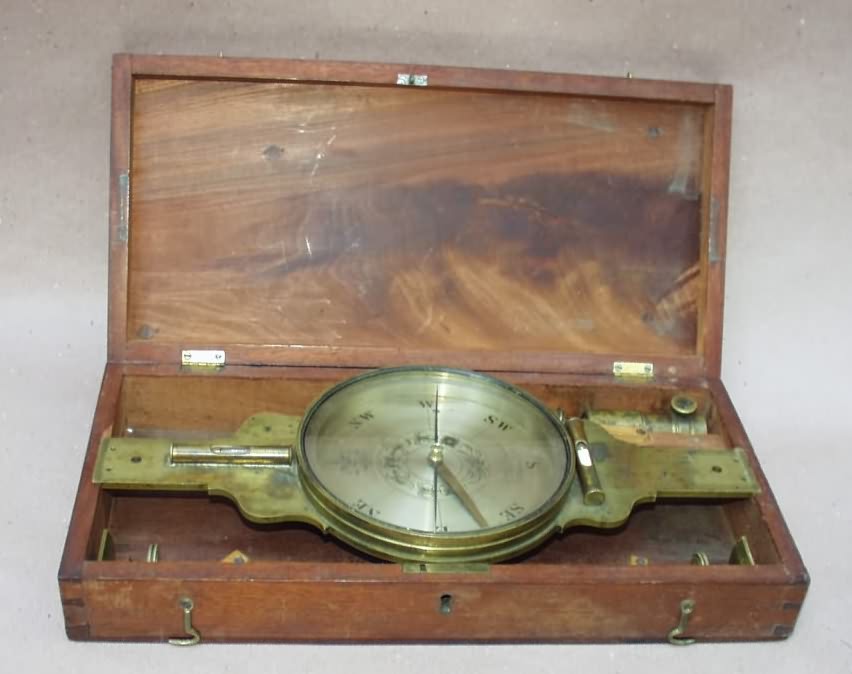
of surveying compasses include Plain and Vernier compasses, Railroad compasses, Mining compasses,
and Solar compasses. Each of these different styles of compasses
had features allowing them to perform specific tasks or functions, and were used to accomplish different tasks as their name implies.
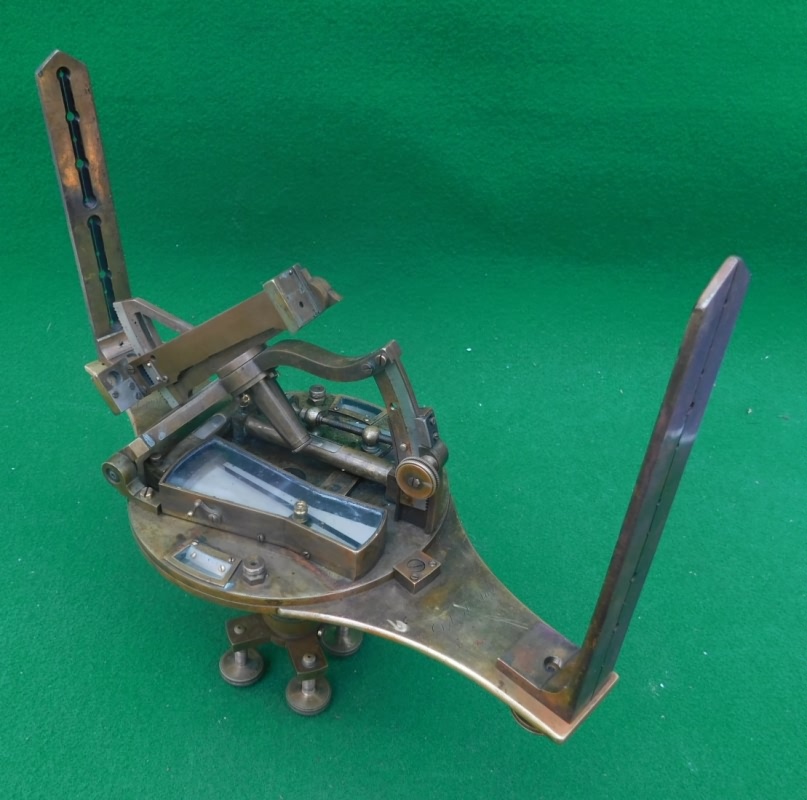
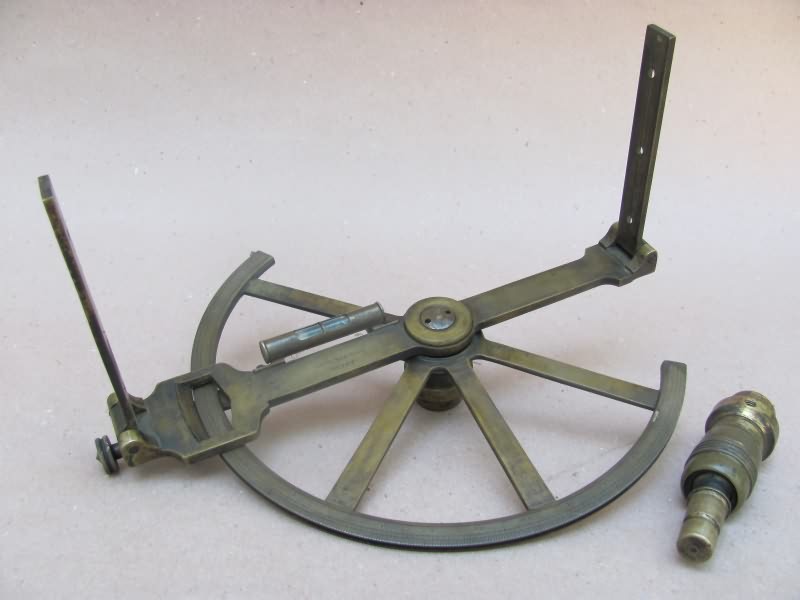
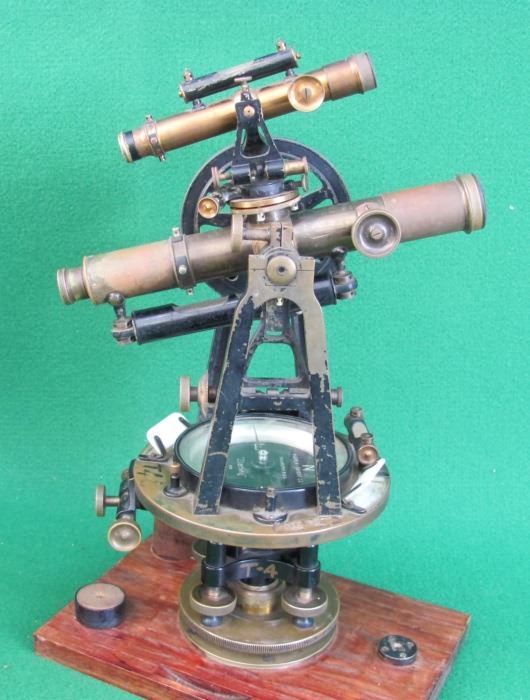
More complex and job specific compasses such
as mining compasses and transits came with provisions for
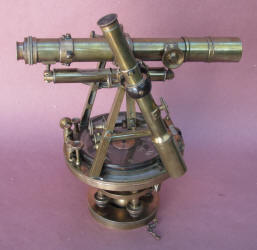
auxiliary \ scopes to allow for shooting over the plate and for determining angles.
(See example to right) Solar Instruments were developed in order to allow
the operator or surveyor to better determine his location by using the sun
and horizon as reference points. These were especially useful in
areas where the magnetic deviation affected the needle compass bearing. Different variations on these themes
were developed
and each company or maker offered their own unique version.
These later job specific Surveying instruments
were offered by manufactures like William Young, Gurley, and Keuffel & Esser,
Buff, Berger, Warren & Knight, Lietz, Dietzgen, Sala, and many others. These well known
names represent the larger makers but many examples by smaller makers are
known as well.
To see vintage surveying instruments by well known makers such
as Gurley, Thaxter,
Queen, Lietz, Dietzgen, Keuffel & Esser, Buff, Berger, Heller
& Brightly and a host of others that I have sold in the past,
here is a link to the
Surveying Instrument
Past Sales Archive Page on our
informational sister site
www.AntiqBuyer.com.
Surveying Compasses
The first instruments used to explore, survey
and divide up America came with the early settlers and explorers from
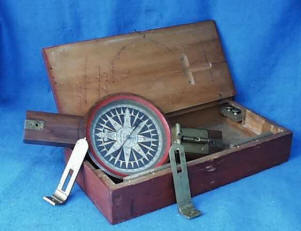 England
and the original homelands of these early explorers and adventurers.
During the earliest colonial times most of the available instruments in
America were manufactured in England and were distributed in America
from the largest cities such as New York, Boston and Philadelphia which
were located along the Eastern seaboard or had access to large bodies of
water or seaways. England
and the original homelands of these early explorers and adventurers.
During the earliest colonial times most of the available instruments in
America were manufactured in England and were distributed in America
from the largest cities such as New York, Boston and Philadelphia which
were located along the Eastern seaboard or had access to large bodies of
water or seaways.
It was not long before the demand for surveying
and related instruments outstripped the limited supply of imported instruments
and a new industry began to develop here in America. These same areas
also became the centers of manufacturing activity in early America and expectedly
the locations or home base of the earliest American surveying instrument
makers.
These earliest 18th century instrument makers included Anthony Lamb and
Thomas Briggs of New York, and Aaron Breed of Boston.
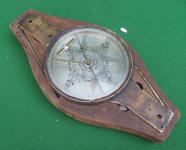
Early makers of surveying and other mathematical instruments from the Philadelphia
area included Benjamin Condy and James Ham, as well as the more recognizable
names, David Rittenhouse and his brother Benjamin Rittenhouse who have been said
to have made George Washington's surveying instruments and compasses for him
when he was a surveyor prior to the American Revolution. The Rittenhouse brothers also
interacted with other prominent American figures such a Franklin and Adams.
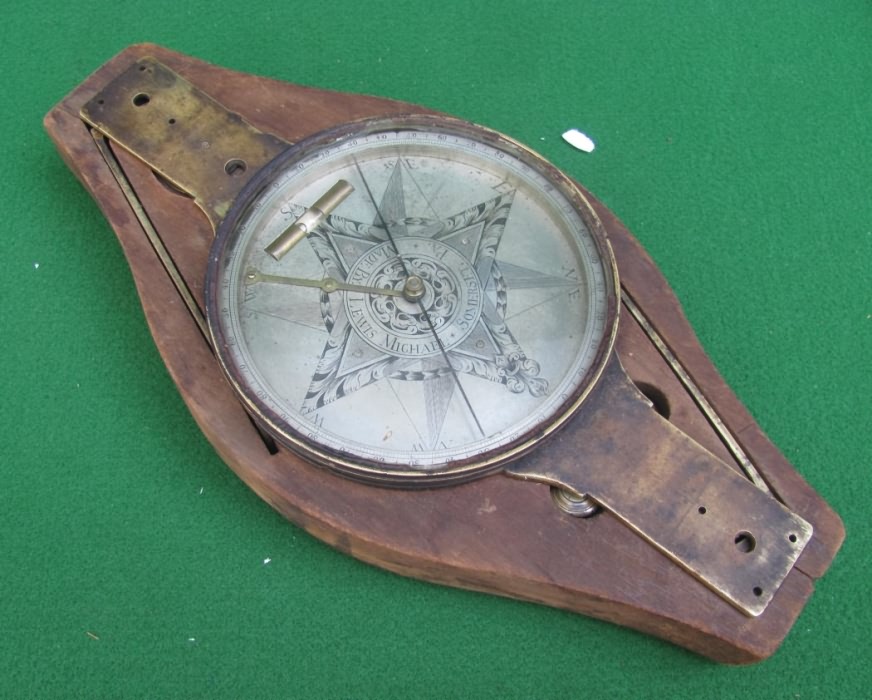
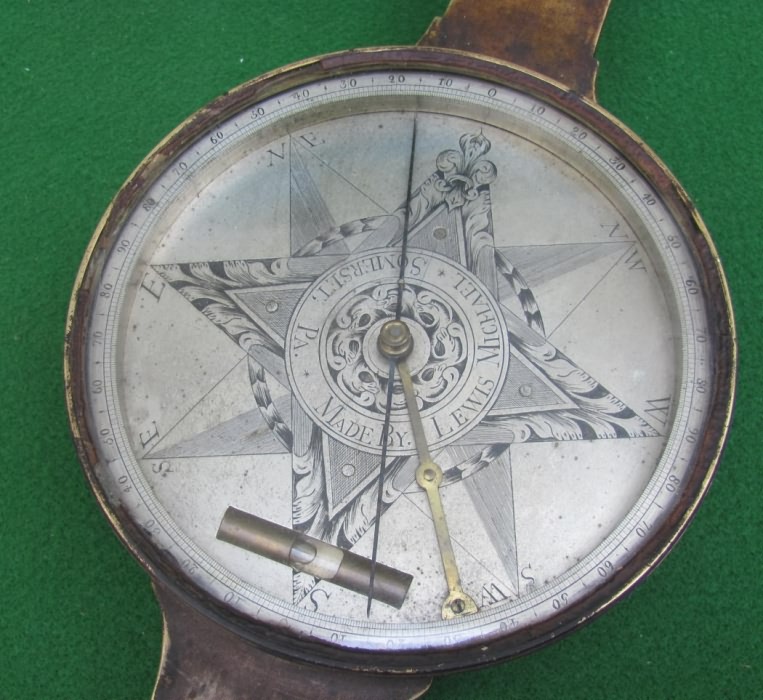
On the right is a Lewis Michael Compass. Note the engraving. It is
like art. Lewis apprenticed to Benjamin Rittenhouse, and his instruments
are even more difficult to find than either of the Rittenhouse brothers compasses.
Early Wooden Surveying Compasses by colonial
era makers are becoming ever more difficult to obtain.
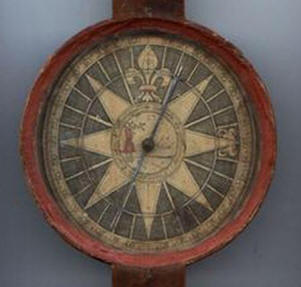 Wood was utilized for several reasons, availability and ease of
construction being the main ones. The earliest makers and pioneers
in the development of surveying instruments were "Yankee's in the truest
sense of the word. They made do with the materials at hand.
Even though brass is relatively easy to work, non magnetic, and adaptable
to the form needed, wood was an even easier material to work with and in
ready and plentiful supply. The vast majority of these early compass
makers, that utilized wood as the basic material for the bodies of their
instruments, originated from the New England area. Many of these
first American made examples are seemingly crude and rudimentary, but have
a and presence or sense and persona that once appreciated and understood make them
very appealing. Wood was utilized for several reasons, availability and ease of
construction being the main ones. The earliest makers and pioneers
in the development of surveying instruments were "Yankee's in the truest
sense of the word. They made do with the materials at hand.
Even though brass is relatively easy to work, non magnetic, and adaptable
to the form needed, wood was an even easier material to work with and in
ready and plentiful supply. The vast majority of these early compass
makers, that utilized wood as the basic material for the bodies of their
instruments, originated from the New England area. Many of these
first American made examples are seemingly crude and rudimentary, but have
a and presence or sense and persona that once appreciated and understood make them
very appealing.
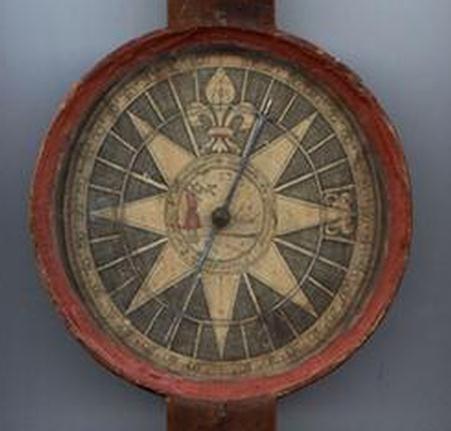
These earliest American examples had paper labels under the glass known as
the compass card. The compass bearings and added graphics were engraved
on a plate, used to make the paper cards. It has even been purported
that Paul Revere provided one Boston Maker with an engraving plate that
he purportedly used to make his compass cards with. Some of these
were works of art depicting scenes with animals or
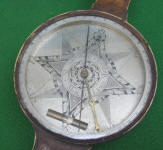 landscapes or even people
at work. Compasses from areas like New York and Philadelphia were typically
made of brass and their compass faces can be highly decorated or engraved
with intricate and beautiful geometric designs like the example to the right
by Lewis Michael.
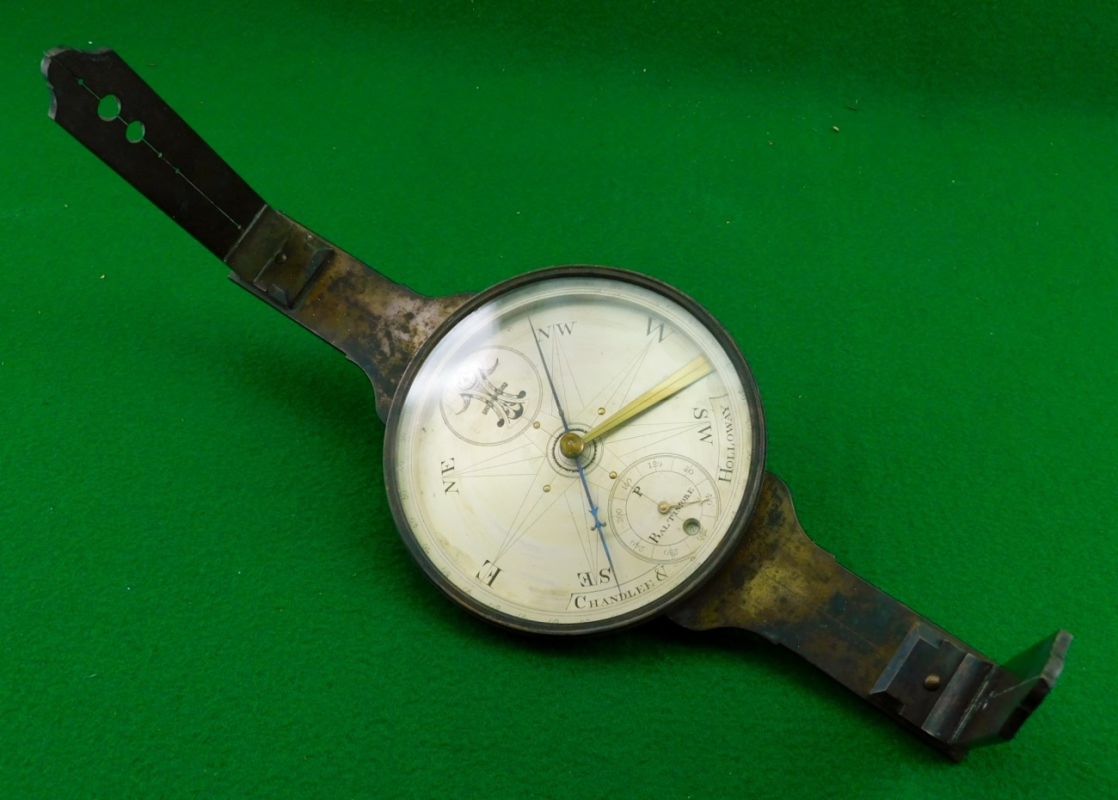
Most later examples became much simpler with just a Fleur De Lis at the
north point and the other points called off
with simple arrows leading to them engraved on the face.
landscapes or even people
at work. Compasses from areas like New York and Philadelphia were typically
made of brass and their compass faces can be highly decorated or engraved
with intricate and beautiful geometric designs like the example to the right
by Lewis Michael.
Most later examples became much simpler with just a Fleur De Lis at the
north point and the other points called off
with simple arrows leading to them engraved on the face.
The list of individual makers of all forms of
surveying instruments continued to grow along with America throughout the
19th century. The major makers continued to be concentrated in or
near the major cities and hubs of activity, but the list of instrument makers from other
areas began to grow with people setting up shops in places like Western
PA, different parts of Ohio, Maryland, Virginia,
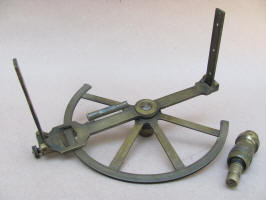 and elsewhere. Saint
Louis also became a center of activity with its strategic local and jumping
off point on the Mississippi River for the trek west. The first and
best known California makers of surveying instruments were Schmolz of San
Francisco, followed by John Roach who moved there from New York after a
partnership with Warner in the mid 1800's and finally Joseph Sala who took
over the Roach business after his death. and elsewhere. Saint
Louis also became a center of activity with its strategic local and jumping
off point on the Mississippi River for the trek west. The first and
best known California makers of surveying instruments were Schmolz of San
Francisco, followed by John Roach who moved there from New York after a
partnership with Warner in the mid 1800's and finally Joseph Sala who took
over the Roach business after his death.
The list and examples of known compass makers number in the many
hundreds and there is a comprehensive although not complete list of known
instrument makers and examples of their instruments documented and pictured at the
Virtual Museum of Surveying compass makers directory which can be found
at
https://www.surveyhistory.org/compass
makerdirectory.htm. There is also a comprehensive list as the
Smithsonian site as well as references available in book form by
Smart and others.
Surveying Transits and
Theodolites
The next major step in the evolution of surveying
instruments made in America, the introduction of the transit, is attributed to William
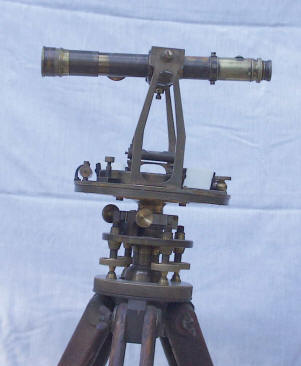 Young of Philadelphia who is
credited by some with designing and manufacturing the first American transit
in approximately 1831. Young began working in Philadelphia in the 1820's
and is also credited with having made the first dividing engines in America
which were touted to be second to none and the largest in the known world.
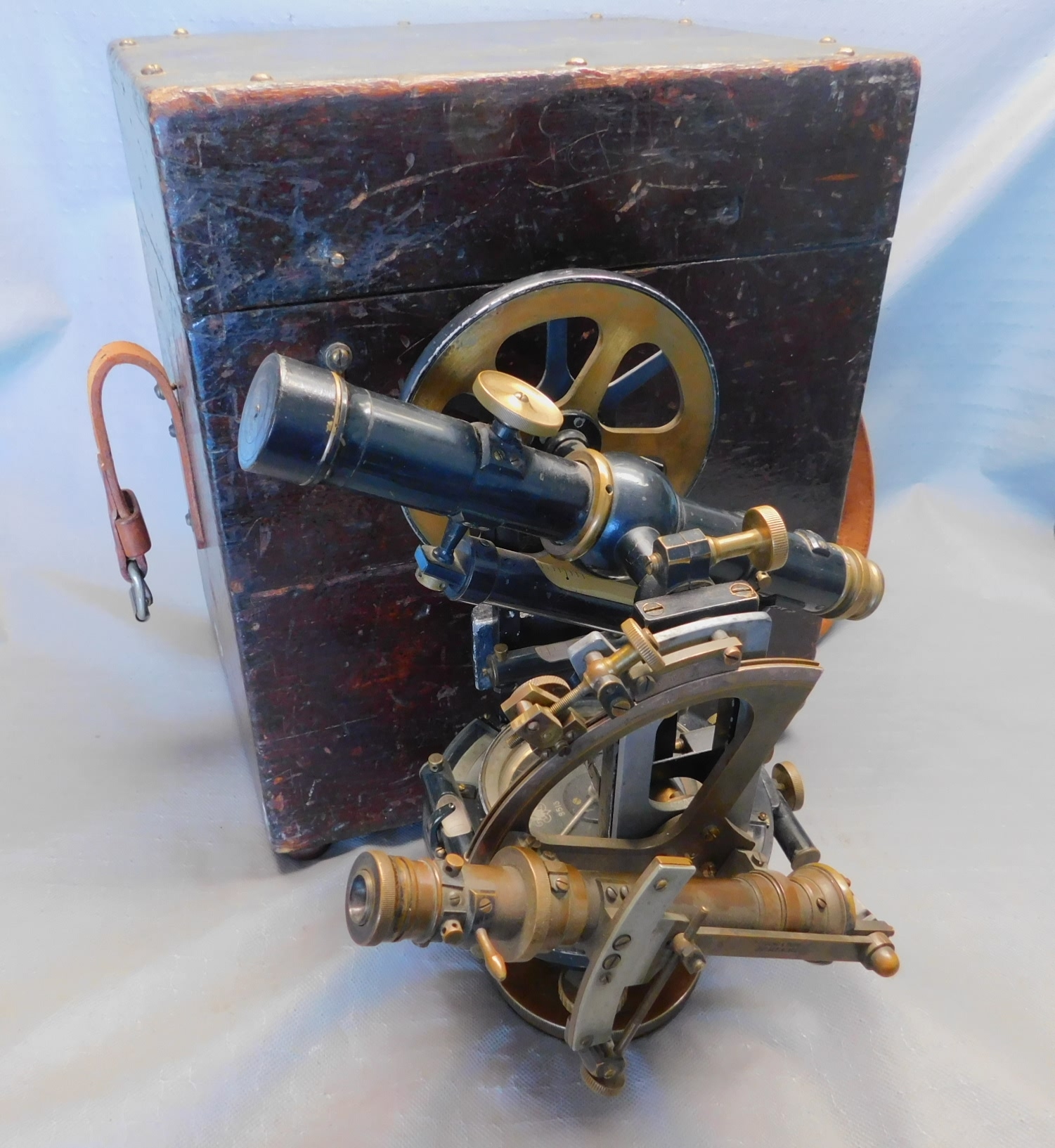
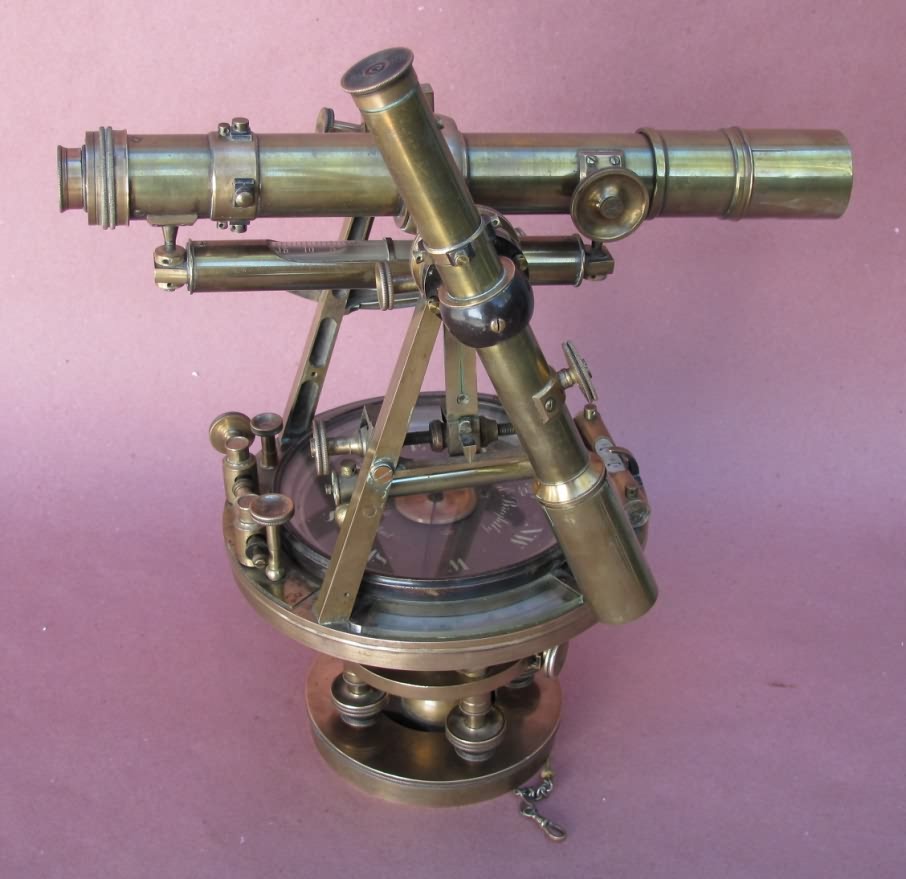
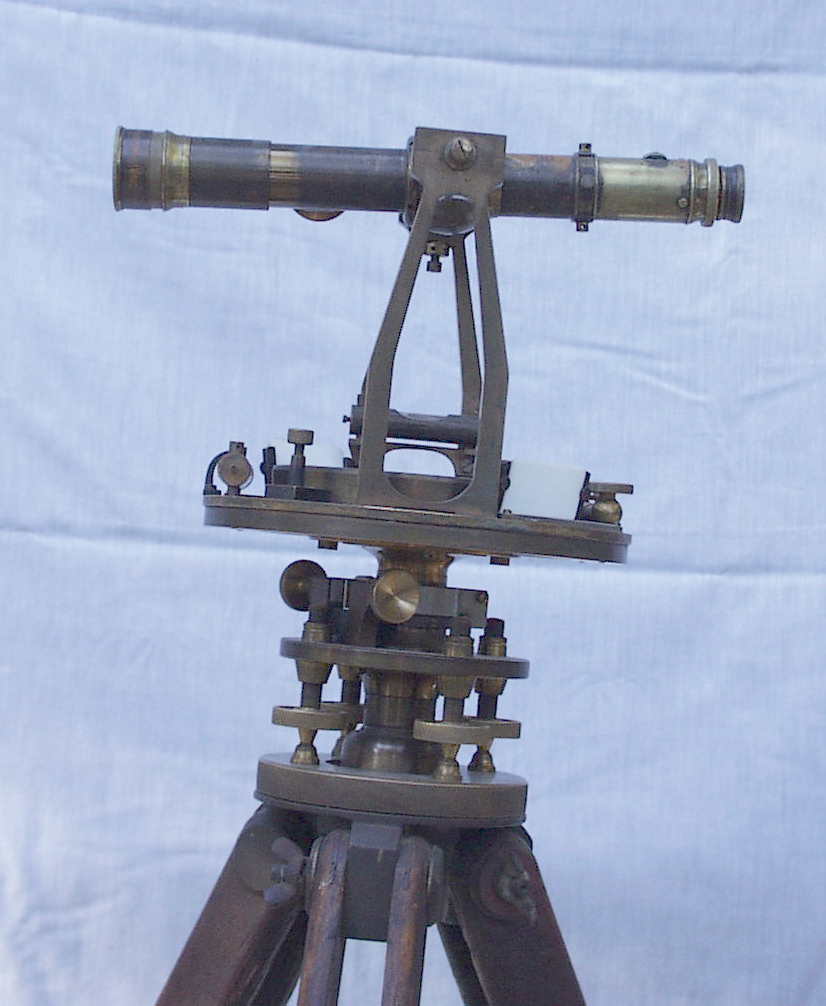
This firm continued in business until 1918 when they finally sold out to Keuffel & Esser or K & E of Newark NJ. The basic
design he used for his transits continued for nearly 100 years and an
example is shown to the left. There is another one of his early
instruments pictured at the Smithsonian site dealing with surveying
instruments at that site. Young of Philadelphia who is
credited by some with designing and manufacturing the first American transit
in approximately 1831. Young began working in Philadelphia in the 1820's
and is also credited with having made the first dividing engines in America
which were touted to be second to none and the largest in the known world.
This firm continued in business until 1918 when they finally sold out to Keuffel & Esser or K & E of Newark NJ. The basic
design he used for his transits continued for nearly 100 years and an
example is shown to the left. There is another one of his early
instruments pictured at the Smithsonian site dealing with surveying
instruments at that site.
Transits and Theodolites are basically a further
improvement over the surveyors compass which was also offered with a scope
as an accessory. The major difference being that the scope was fixed
over the compass and it was offered as a single unit. The earliest
transits did not have the ability for the scope to be revolved on its axis
---- to shoot behind it as well without turning the whole instrument 180
degrees, or removing and re-seating the scope 180 degrees. This was due partly to the quality of the optics available
necessitating longer scopes, and partly to the basic idea simply was not
thought of or employed in the initial design. Over the years, these
attributes were incorporated into the transits design without fanfare.
Originally instruments that were not able to revolve on their axis were
designated as theodolites, but over time the use of the word theodolite was changed
or expanded to include more precise instruments that not only had this ability,
but were so intricate and precise that small magnifiers were needed to insure
proper recording of what the scales indicated.
As with compasses, transit were offered in different
designations according to size or function. Transits without compasses under the scope
are called Builders transits and were used for simple layouts
or laying of straight lines. Expedition transits are
unusually small w/ scopes approx. 6" long. Light mountain
transits had 8 - 9" scopes. Surveyors transits were 10 ' 12" long and
usually had a compass and vernier circle of some sort. Architects
transits are similar size typically with out a vertical vernier.
The vertical vernier was offered in different sizes
and configurations for different applications and many transits did not
utilize them at all. Transits could be ordered in many sizes and different
configurations leading to a myriad of small differences that can be encountered
even in models carrying the same model number from makers like K & E or
Gurley.

Our interests in buying and selling of antique
surveying instruments is focused on more complex
instruments that include surveying transits of all sizes and forms.
Each company or maker designated different models in their own way, but
in general are commonly referred to by their size or application with names
such as Expedition transit, Explorer, Light Mountain, Engineer's transit,
Architects transit, Railroad transit, Solar transit, Mining Transit and
more. I have detailed and discussed just some of the aspects concerning
specific details related to these different surveying instruments to clarify
what we typically sell and are seeking to buy but there is much involved
that has not been touched on.
During this period during the mid to late 19th
century many different surveying instrument makers came onto the scene and
entered the
marketplace.
Partnerships were formed and dissolved, and individuals moved from town
to town or left the scene altogether for one reason or another.
For example, W. L. & E Gurley the surveying instrument maker who became
the dominate force in the field evolved from members first apprenticing
to, or from their associations with, the earlier individual makers in upstate
NY area like Menelly and Hanks. Gurley then moved on to form the small partnership
of Phelps and Gurley and then on to the partnership formed amongst
the father, sons, and family members of the Gurley family that became
known as the W. L. & E Gurley Co. of Troy New York.
Antique & Vintage
Surveying Instruments Wanted
Antique surveying instruments, including transits,
theodolites, compasses, solar instruments and other
forms of
vintage surveying instruments hold a

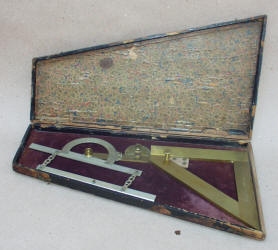 special interest for us. Our focus both
in buying and selling these interesting scientific artifacts is primarily focused on antique
surveying instruments of American origin. We are especially looking
for earlier 18th & 19th century instruments and more unusual forms
of early surveying instruments such as solar or mining transits and compasses.
We are always interested
in buying or helping you sell similar instruments if you have something
of interest. You can look at some of the past sales results of
instruments we have sold in the past at our sister site
www.AntiqBuyer.com on
the Surveying Instrument
Past Sales Archive Page
INFO ABOUT DATING
Antique & Vintage Surveying Instruments

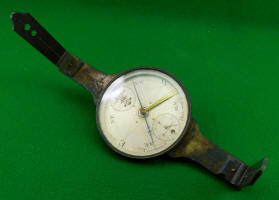 Here is a link to a website that can help you
date your surveying instrument if you are looking for that info.
Here is a link to a website that can help you
date your surveying instrument if you are looking for that info.
https://www.surveyhistory.org/how_old_is_my_instrument.htm
Antique & Vintage
Surveying Instruments Bought / Sold & Wanted
To see various Antique & Vintage surveying instruments that I have sold
in the past by well known makers such as Gurley,
Thaxter, Queen, Lietz, Dietzgen, Keuffel & Esser, Buff, Berger, Heller & Brightly and others, here is a link to the
Surveying Instrument
Past Sales Archive Page at our sister websitewww.AntiqBuyer.com
picturing and describing many of the antique surveying instruments I have previously sold.
* * * * We Buy & Sell Antiques! * * * *

We want to Buy Quality Surveying Related Antiques
If you have a single antique, or a collection of antiques to sell
please Contact Patented-Antiques.com at patentedantiques@gmail.com giving us your
PHONE NUMBER and other contact info and we will get back to you ASAP.
Thanks!! |